brink or threshold
TL;DR with Southern Oregon economy's K-shaped recovery curve in mind, our ec dev toolbox needs to evolve accordingly because the success stories are real, and so are the challenges
It has been exactly 74 weeks since I heard the phrase "we're living in unprecedented times" and I don't miss it. Does anyone? I both do and don't miss pivoting, the new normal, she-cession in my LinkedIn feed. New buzzwords came and went, replacing them. March is Women's History Month, I suggest you look that last term up if you have not encountered it recently.
This week, while celebrating undeniable and inspiring successes of Southern Oregon highlighted at the annual events held by both Klamath Economic Development Agency and the Southern Oregon Regional Economic Development, Inc (January 28 and February 28, respectively) I am welcoming one particular concept from the pandemic era conversations. The K-shaped Recovery Curve. It seems to affect everything on my radar this week. And thinking about it helps me process the dichotomy of mind-blowing successes and growth enjoyed by multiple sectors in my region and others' challenges for which no immediate federal nor state rescue resources are available . The economy shifted just in my tenure in Southern Oregon. Businesses that readily responded to its demands or had pandemic-informed launches were able to hit the mid-'20s running. Of those that survived, many expanded. The businesses that moved up along the arm of the letter K hired additional people, continued to give back to their host communities, are still faring well for the most part.
In my world, we say that rural communities are the first ones to feel the impacts of a recession and the last ones to climb out of it. Six years and six days after my world went into the shutdown mode, I see the world as a hard binary: communities and census tracts that are doing ok/well or those that inevitably took a dip, faithfully following the slide of the leg of the K from the joint, the typographic term for the fulcrum where the letter visually bifurcates.
Many communities are doing well. They are not the ones I see nor hear from often and therein lies my bias. And yet the sample size of rural Southern Oregon I get to hear from is numerous, real, and valid. The dashboards and tools I use to track where Southern Oregon communities across Jackson, Josephine, Klamath, and Lake Counties, which I serve in my economic development practitioner role, paint a complex picture. Perhaps I will address regional GDP in a subsequent post but I had to start with people.
The Oregon Community Foundation's Oregon Opportunity Atlas 1 shows that children born in low-income households in Merrill and Malin (Klamath Co) have higher levels of opportunity than their socioeconomic birth status peers in Medford (Jackson Co). This could reflect that the former are more likely to pursue paths elsewhere - breaking out of the earning potential constraints of their birth locale more than their Medford peers, possible. It also could reflect the sheer number of those children being fewer, whereas Medford by the sheer virtue of being the MSA of the region may count thousands more children who are not likely to achieve the economic opportunity defined as "high".
Oregon by the Numbers 2, one of my favorite Oregon-specific tools out there, indicates that the average life expectancy for males in Klamath County is 5 years less than in Lake County. And yet again, while I know what my colleagues in Klamath would say is the usual suspect for that disparity, I am left wanting to dig deeper to see whether Lake County's quality of life and the Oregon Outback Magic is helping people live longer or whether things are merely less dire in a County which is not on an interstate corridor.
Accessed through the US Department of Transportation's Grant Project Location Verification tool 3, the color-shaded census tracts reflect that Southern Oregon's primarily rural and unincorporated areas are considered to be those of persistent poverty. Yet most businesses are concentrated in or near the population centers, from what I see on the Secretary of State registry page.
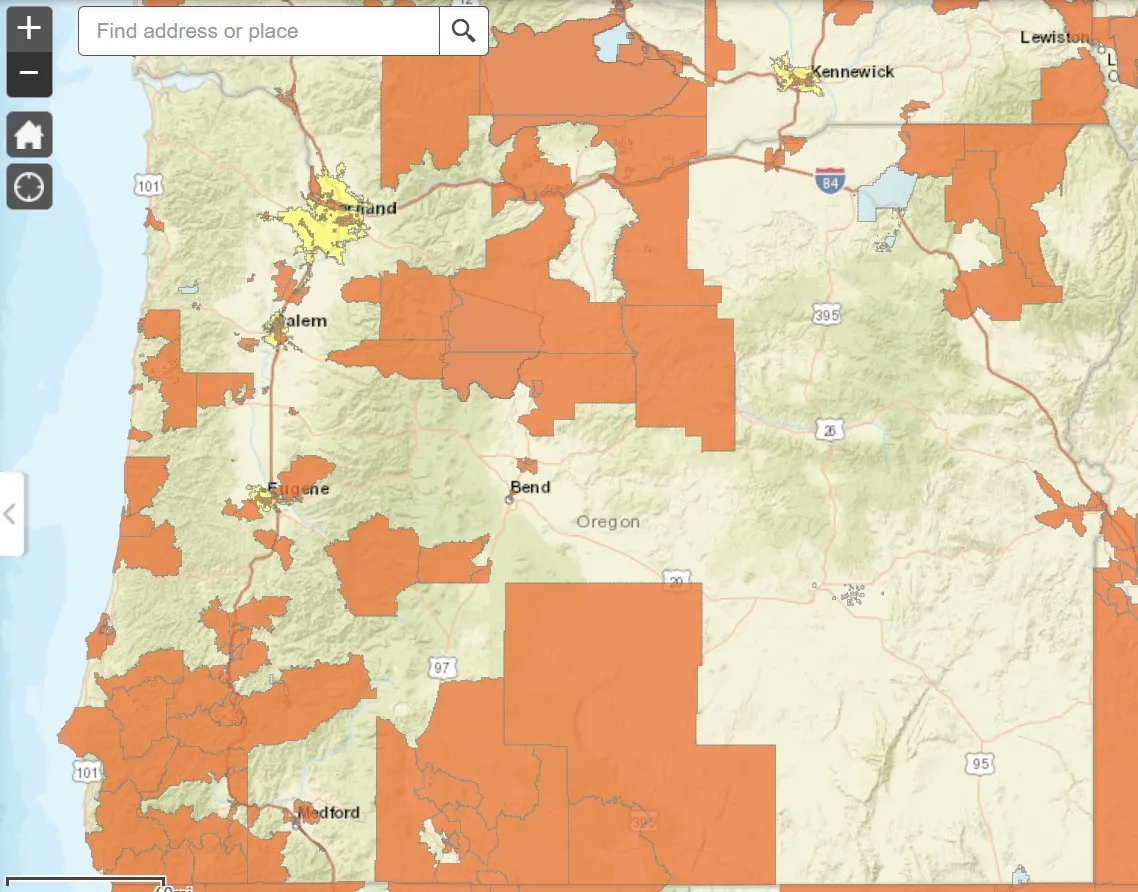
The question in my mind is balancing the economic development toolbox for growth among those who are thriving while leaving no business and not for profit that's trying to climb back up the K-leg to get back to pre-pandemic business or funding levels. Pockets of Southern Oregon are experiencing decreases in funding levels relatively the rise in costs of continuing to offer existing service levels to their focus populations. I am infinitely grateful for the dashboards that OCF and FFF offer at no cost to Oregon and my peers to help us make sense of the duality I am observing, one that a K-Curve lens explains best to my brain. My economic development toolbox was planned for and shaped by past sine-wave shaped fluctuations in the economy, occasionally challenged by generational changes, such as the decline in timber revenues, or the 2008/2009 recession. The toolbox has not bifurcated the way that our business recovery curve has. It lands in the middle, the point from which my world moved on radically six years and six months ago.
In this blog, I hope to share thoughts on supporting an economy that won't go back to its pre-2020 box. Thanks for reading.
NB and a change-maker shout-out: I applaud Healthy Klamath for being a voice in acknowledging the state of things and what's being done about it. Without talking about what's affecting us and our neighbors, we cannot in earnest say that we are working on solutions.